Brad-point drills
for pen blanks.
A true woodworking brad point has a centered locating brad, two main cutting lips, and two outlining spurs. The brad establishes the axis; the spurs score the hole wall before the lips remove the core. That geometry can produce a clean, deliberate start in wood—but flute capacity and the grind chosen for the actual blank still matter in a deep pen bore.
- Best case
- Solid wood
- Main strength
- Clean, located entry
- Watch closely
- Heat and chip packing
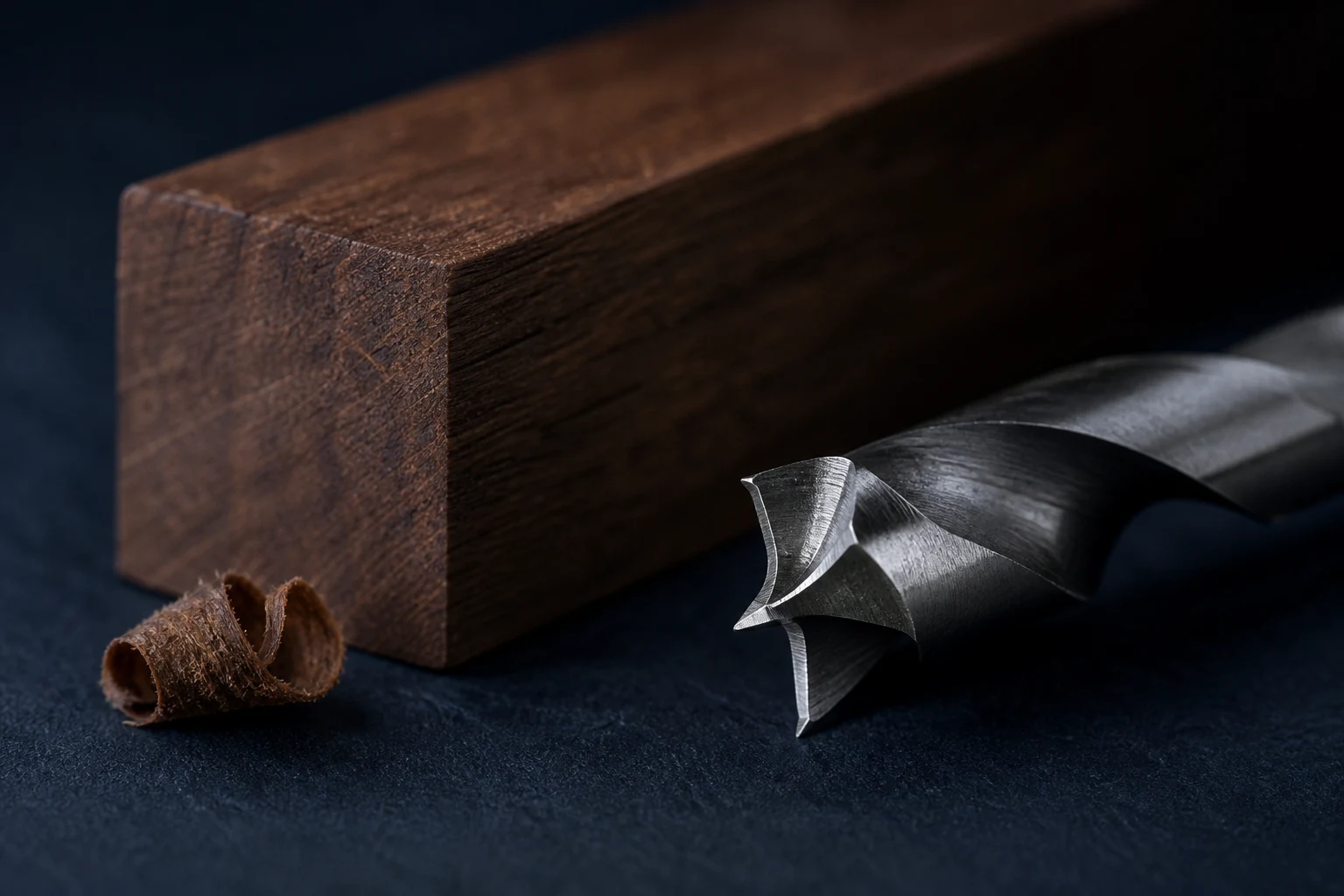
Choose the geometry for the blank—not the label on the package.
A sharp, straight brad-point bit is a strong candidate when a wooden blank needs a clean entry and the exact kit diameter is available. For a long bore where chip evacuation is the limiting problem, a parabolic-flute or purpose-ground pen-maker bit may be the better tool. Woodcraft makes that distinction directly in its pen-drilling guidance.68
Three features decide how the hole begins.
The silhouette is easy to recognize; the quality is in whether its three working elements share the same axis.
Center brad
The narrow pyramidal point enters first and locates the axis; it mainly scrapes and displaces rather than clearing the hole. It should be centered between the lips. An off-axis or overly thick brad increases thrust, runout, and oversize cutting.1
Outlining spurs
Two spurs at the outside diameter sever fibers before the main lips arrive. Their symmetry determines whether both sides score together. Sharp pointed spurs are a common hardwood grind; rounded spurs are a specialist softwood grind.1
Cutting lips and flutes
Two main lips remove the core while two helical flutes carry chips out. A pen blank is a deep bore relative to bit diameter, so polished, open flutes and frequent withdrawal may matter more than clean entry alone.96
Sharp outlining spurs
Pointed spurs cut stronger fibers cleanly with little rubbing. Fuller notes that this reduces unnecessary heat in hardwood. This is the more likely geometry for dense natural and stabilized pen blanks.1
Rounded outlining spurs
Rounded spurs press weaker fibers down before shearing them, which can reduce a ragged entry in softwood. The extra rubbing can create heat and high thrust in hardwood; do not assume this grind from the package label alone.1
Hardwood is not a synonym for hard. Hardwood and softwood describe botanical groups, while density and mechanical properties vary widely among and within species. Identify the blank, its moisture or stabilization state, and its actual cutting behavior. The dark blank in these illustrations represents walnut; use the same inspection process for maple, cherry, tropical species, pine, cedar, and engineered blanks.11
What separates a useful bit from a frustrating one.
Evaluate the individual size you will use. A beautiful 25-piece set is irrelevant if its 10.5 mm bit is short, eccentric, or missing.
A brad point is not a universal pen-blank bit.
Dense natural hardwood
A sharp-spur, fully ground HSS brad point suits many walnut, hard maple, cherry, and exotic blanks. The sharper spur shears strong fibers without the rubbing built into a rounded softwood grind; peck before chips glaze or pack.19
Softwood or fibrous stock
Pine, cedar, and similar blanks can produce larger, stringier, sometimes resinous chips. A rounded softwood spur may hold fibers down better, but open polished flutes, shorter pecks, and a backed-up exit are equally important.195
Stabilized wood
Resin fills pores and changes heat and chip behavior. Pen-specific HSS brad points are sold for stabilized wood, but test a cutoff, keep the bit cool, and compare a parabolic-flute bit if chips smear or bind.10
Cast acrylic and resin
Some manufacturers rate brad points for plastics, but brittle or heat-sensitive blanks vary. Use the blank maker's point recommendation and peck frequently rather than assuming a wood grind is safe.
Stone and stone-like blanks
PSI's stone-blank drilling system explicitly says not to use brad points; it uses carbide pilots followed by standard or acrylic-point drills.7
Very deep bores
If the bit must spend most of its flute length inside the blank, chip evacuation may outweigh the entry advantage. This is where parabolic-flute pen-maker bits deserve a direct comparison.6
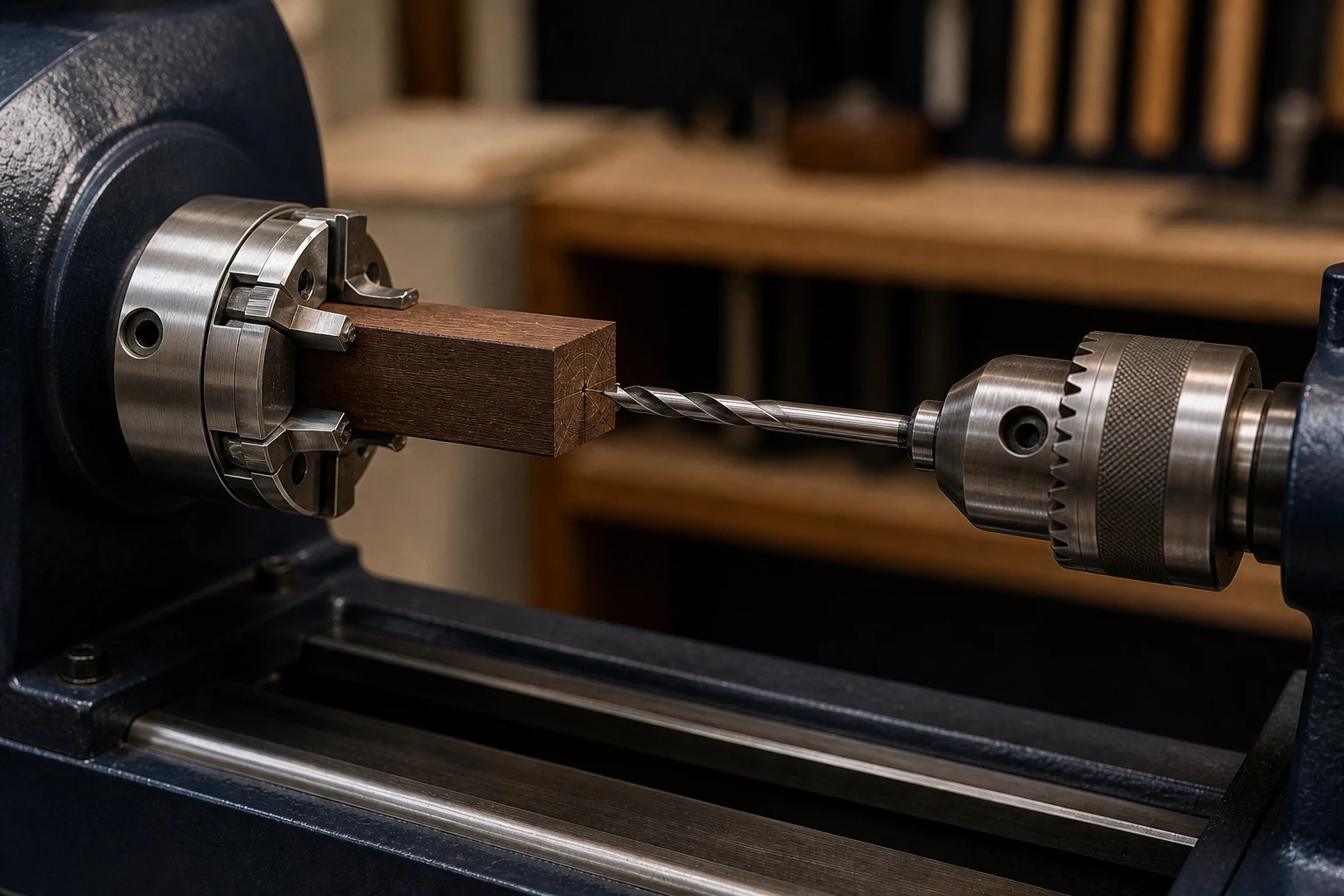
Control alignment, feed, chips, and heat.
- Use the kit size.
Read every barrel requirement; cap and body may use different drills. Do not round metric, fractional, or letter sizes unless the current instructions list an alternative.
- Hold the blank on axis.
Use suitable pen-blank jaws or a verified fixture. With a drill press, make the table perpendicular and support the exit with scrap to reduce tear-out.5
- Check the rotation before cutting.
Turn the spindle or chuck by hand with power off. The point should not orbit, and the blank should not wobble.
- Start conservatively.
PSI documents the slowest lathe speed, about 600 rpm, for its drilling-jaw setup. Treat that as a fixture-specific starting reference—not a universal speed for every diameter and material.4
- Peck for the wood in front of you.
Advance steadily and withdraw before the flutes pack. Dense hardwood often makes small chips or dust; soft, wet, or resinous wood can make larger chips that bridge the flute. Remove packed chips with the machine stopped and let the bit cool.94
- Judge the result.
Inspect the entry, bore wall, and exit. Dry-fit the brass tube: it needs room for the specified adhesive, but excessive rattle points to runout, oversize geometry, or the wrong drill.
Pick the bit whose weakness is easiest to manage.
These are relative tendencies, not guarantees. Grind quality, runout, diameter, flute length, blank material, workholding, speed, and feed can reverse the result.
Retire, regrind, or reject the bit when…
- The brad visibly orbits in a known-good chuck.
- One outer spur reaches the wood before the other.
- The point is chipped, rounded, corroded, or heat-blue.
- The bore grows bell-mouthed or consistently oversize.
- The fluted section cannot reach the required depth safely.
- Clearing chips does not stop heat, squeal, smoke, or steering.
References and further reading
Manufacturer instructions describe their own tools and fixtures. Use them as evidence, then follow the current instructions for your exact kit, blank, machine, and drill.
Manufacturer guidance on center brads, hardwood versus softwood spur profiles, and point selection.
Open source ↗02Lee Valley ToolsUtility Brad-Point Drill BitsProduct specifications emphasizing low runout, clean entry, accurate sizing, and high-speed-steel construction.
Open source ↗03Lee Valley Tools10.5 mm HSS Brad-Point Drill BitA pen-making-specific example with a 5-inch overall length and 3 1/4 inches of fluting.
Open source ↗04PSI WoodworkingPen Blank Drilling Jaws instructionsLathe drilling setup, appropriate bit diameter, slow-speed starting guidance, and chip-clearing procedure.
Open source ↗05PSI WoodworkingSelf-Centering Drilling Center Vise instructionsDrill-press alignment, perpendicular workholding, and backer-board guidance for reducing exit tear-out.
Open source ↗06WoodcraftHow to Make Pens and PencilsPen-blank drilling guidance comparing brad points with parabolic-flute bits for deep-hole chip evacuation.
Open source ↗07PSI WoodworkingStone Blank Five-Bit Drilling Set instructionsMaterial-specific warning not to use brad points with PSI's stone-blank drilling system.
Open source ↗08WoodcraftBeginner's Guide to Pen MakingPractical comparison between a good brad-point bit and pen-maker bits ground for straight, deep holes.
Open source ↗09FAMAG ToolsDELTA-F brad-point geometryManufacturer explanation of fully ground HSS geometry, hard-wood cutting, softwood chip volume, flute finish, and heat control.
Open source ↗10Lee Valley ToolsLetter O, V and Z HSS brad-point drills for pen kitsPen-kit-specific HSS brad points with sharply defined lips for hardwood, stabilized wood, and acrylic acetate.
Open source ↗11USDA Forest Products LaboratoryWood Handbook: Wood as an Engineering MaterialPrimary technical reference for wood structure, density, moisture, species variability, and mechanical properties.
Open source ↗